
Grant Carson: Disability Qualified Tribunal Member, First-tier Tribunal
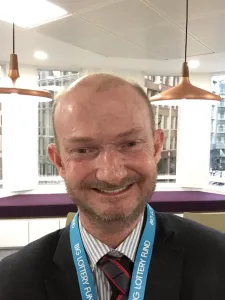
“As a DQTM I find a great deal of job satisfaction being part of the fair administration of the justice system, ensuring that people who are entitled receive the money they are entitled to and those who are not entitled understand why.“
Background
I was diagnosed with a chronic arthritic condition when I was 7 years old. I spent a lot of time in hospital during those early years, my disease was very active, and my immune system seemed intent on taking my life. Fortunately, with the support of my mum and our wonderful NHS my condition gradually stabilised. By this time, I had missed over half my secondary education through ill health and hospitalisation, and left school without sitting any exams.
At 16 years old I left home and went to college staying in a residence specifically for disabled students. It was fully accessible and had 24/7 support available to meet the needs of a very diverse group which included visual impairments, hearing impairments (sign language users) mental health issues, learning difficulties, and a broad range of physical impairments including high level spinal injuries, cerebral palsy and spina bifida.
It was through forming friendships with this community that I realised, irrespective of our impairments, we all struggled with common barriers. Things like the lack of accessible transport, social and recreational opportunities, negative attitudes, stereotypes and a broad range of environmental barriers very often stopped us from doing the things we wanted to do.
As students on limited income, we were also acutely aware of the extra costs of being disabled people and the importance disability benefits have in enabling choices and independent living. For example, those of us in receipt of disability benefits were more able to afford taxis to go out and socialise.
After gaining some qualifications and going to Glasgow University my first job was not related to either of my degrees. I accepted a job as a Welfare Rights Officer for Blackwood Housing providing benefits advice to tenants across Scotland. 50% of Blackwood tenants were disabled people living in wheelchair accessible housing. Working with this client group I was able to experience all stages of the benefits system from initial application, to appearing as a representative at First-tier Tribunals. Over the next 2 years I had a huge amount of job satisfaction, successfully claiming significant amounts of benefits and seeing first-hand how an award can transform a disabled person’s quality of life.
After this I worked in a charity development role for 27 years and was eventually promoted to Deputy Chief Executive within a Centre for Independent Living. I was fortunate enough to work with a great team, many of whom were also disabled people. Together we developed and ran a range of independent living support services helping disabled people lead full independent lives in the community. The experience of working in an organisation supporting up to 3000 disabled people a year again reinforced my knowledge and understanding of the many medical conditions which can affect different people in different ways. Just as importantly, I gained experience identifying and removing the barriers which prevent disabled people from achieving equal opportunities in all aspects of their lives.
The application
In 2008 I applied to become Disability Qualified Tribunal Member (DQTM) within the Ministry of Justice (MoJ)/Independent Tribunal Service. I applied because of my long-standing interest in the benefits system, social justice and equal opportunities for disabled people.
There was a competitive recruitment exercise comprising of a written application form followed by a day of assessment and role play. Tribunal Members need to have good attention to detail, the ability to analyse and quickly assimilate complex information, be good at communicating with people at all levels, manage their work effectively, make considered decisions based on evidence, understand the law appropriately and work well with others. All these competencies were tested at interview and are regularly reviewed through the MoJ performance review process.
After being appointed and going through the induction training I was able to sit on Appeal Tribunals. DQTM’s sit on tribunals relating to Disability Living Allowance (DLA) for children up to 16, Personal Independence Payment (PIP) for people aged 16 to 64, and Attendance Allowance (AA) – for those who have reached state retirement age.
The role
I find being a DQTM is a very flexible way of working, I can choose what days and how often I want to sit and the allocations team will take my availability into account when allocating appeals. Some DQTM’s may sit one or two days a month as I did when I was working full-time, or you may decide to sit more regularly and use this role as your primary source of income, or to supplement another part-time job. The amount of sitting cannot be guaranteed however, because if there are few appeals coming through then less sessions are available.
In terms of preparation, you receive a Department of Work and Pensions (DWP) prepared bundle which includes any medical evidence, a report by an independent Health Care Professional as part of the DWP assessment process is usually included.
The DWP will set out in their submission the decision being appealed, their rational and evidence for the decision. Case bundles on average are between 100 and 300 pages. So, as Tribunal members we have a lot of information on the person and their appeal before the hearing. All 3 members of the Tribunal will meet up immediately before the hearing to discuss the case, agreeing the key facts of the case and scope of the appeal.
The hearing itself consists of the 3 Tribunal Members (Judge, Doctor and DQTM), usually the appellant either attends, or takes part by phone or video link. There may also be a representative for the appellant and a DWP presenting officer. My role as a DQTM is usually to cover the daily living practicalities, while the Doctor covers mobility and relevant medical conditions. The Judge will chair the hearing, ask any questions for clarification needed and write up the agreed decision.
A successful outcome of an appeal, where evidence shows the claimant meets the criteria for an award of benefit, can make a huge difference to the household income of disabled people and families with disabled children. Increased income can lift people out of poverty and greatly improve quality of life and their ability to take part in normal day to day activities. As a disabled person working as a DQTM, I feel I bring my ‘Lived Experience’ of empathy, adapting, coping and adjusting to a long-term medical condition or impairment, along with the daily problem solving and planning needed to successfully live independently. This ‘Lived Experience’ in my view adds value to our professional experience and gives significant additional relevant expertise to the Tribunal system.
If you are interested in justice, equality, fairness and public service then I would highly recommend working as a Tribunal Member.
Other specialists
Find out more about the wide range of people working in non-legal roles.
Ready to search for your next judicial role?
View all vacancies including upcoming and past recruitment exercises.