
Diversity update: February 2025
Detailing our ongoing work to attract and better prepare potential candidates from under-represented groups for judicial appointments.
Introduction (Back to top)
This update contains background information about our diversity goals along with detailed information covering:
- on-going activities
- new initiatives
- diversity data for applications and outcomes 2023-2024
- statistical insights from 2024
- highlights of the year
Background
- Under the Constitutional Reform Act 2005, the Judicial Appointments Commission’s (JAC) statutory duties are to:
- select candidates solely on merit;
- select only people of good character;
- have regard to the need to encourage diversity in the range of persons available for judicial selection.
- The JAC has identified 4 target groups of people whom data shows are underrepresented in the judiciary: women, ethnic minority individuals, disabled individuals, and solicitors. However, all protected characteristics, as defined in the Equality Act 2010, are considered when carrying out equality measures.
- Our statutory purpose is the independent selection of candidates for judicial appointment on merit from a diverse field. Diversity is at the forefront of our strategy, and one of our strategic aims is to attract well-evidenced applications for judicial office from the widest range of high calibre candidates, supporting greater judicial diversity.
- The JAC Diversity Update is a biannual publication that reports on ongoing progress and new activity undertaken by the JAC in line with the JAC’s diversity strategy. The strategy has three key strands: outreach; fair and non-discriminatory selection processes; and working with others to break down barriers.
Recent highlights
- In February 2025, the Judicial Diversity Forum (JDF) published its priorities and actions for 2025 which sets out the activities that JDF partners will undertake in the next year and how the impact of each initiative will be measured.
- The JAC has developed a new Communications and Engagement Strategy for 2025-2027, which was approved by the JAC Board in December 2024. The strategy places a particular focus on using clear, targeted, and accessible communications to ensure all eligible candidates feel informed and supported.
- In January 2025, the Judiciary published a revised Judicial Skills and Abilities Framework, first introduced in 2014, to reflect the skills required of contemporary and future judicial office holders. The JAC has worked with the judiciary over the last year to assist in developing a framework which can be used across the recruitment, training and development of judicial office holders. The Framework has been developed to be comprehensible and accessible to all. The JAC has announced it is now reviewing its processes in light of the revised framework and candidates will be updated later in 2025.
- Following the publication of the summary of our 2-year research project, which aimed to further explore the differential outcomes observed for some candidate groups at the JAC qualifying test (QT), we continue to implement the actions agreed. Responding to the findings of the JDF Qualifying Test (QT) research project, the JAC and Judicial Diversity Forum (JDF) partners agreed a collective work programme for 2024-25, which consists of a coordinated set of actions aiming to reduce barriers for groups with lower success rates at the QT stage. We have set up a JAC QT working group to deliver against the wider JDF work programme. Actions completed include the publication of new dedicated guidance and changes to the time limits of the QT.
- The fifth annual Diversity of the Judiciary Combined Statistics Report was published in July 2024. The JAC has been using data from the report to underpin further work in the diversity area, and in Section 5 of this Diversity Update we have published a selection of statistical insights. These include an in-depth exploration of the underrepresentation of women in some senior courts roles, and graphs tracking representation of different ethnicities at various levels of legal experience. As part of our work with partners to continuously improve the accessibility and transparency of statistics around judicial appointments, we will be working closely with MoJ statisticians to develop an interactive online statistics tool to accompany the 2025 report. This will allow greater access to time series data across different reporting years and the ability to visualise differences in diversity data across different judicial or professional roles. The tool will assist the JDF in highlighting new or emerging areas of focus from trends.
- The Targeted Outreach and Research Team continues to support underrepresented candidates through the Targeted Outreach Programme. As of November 2024, the programme has received over 950 applications, of which, following sifts by former JAC Commissioners, 526 candidates are taking part in the programme and receiving support from a Targeted Outreach Team Commissioner and/or a judicial guide. Of accepted candidates, 71% are women, 61% are ethnic minority, 18% declared a disability and 66% are solicitors.
1. Targeted outreach and support for potential applicants from underrepresented groups (Back to top)
New activity
- As part of the JAC’s 2024 – 2027 Business Strategy we committed to reviewing our approach to ensure we are attracting the widest possible fields of suitably qualified candidates. This includes the development of a new Communications and Engagement Strategy for 2025-2027, which was approved by the JAC Board in December 2024. The strategy underpins the JAC’s approach to strengthening relationships with candidates, stakeholders, and the wider public. The new strategy places a particular focus on using clear, targeted, and accessible communications to ensure all eligible candidates are well informed and supported.
- The Targeted Outreach and Research Team continues to support underrepresented candidates. In the last 6 months, the JAC has:
- Increased the level of stakeholder engagement alongside Whipple LJ and the senior judiciary, to increase the number of stakeholder referrals to the TO programme.
- Continued to support various initiatives with the Senior President of Tribunals Diversity Taskforce.
- Delivered articles, podcasts and led various outreach events to key stakeholders, professional bodies and prospective applicants from diverse backgrounds.
- Following an internal audit of the Targeted Outreach programme, five key priorities have been identified to further enhance our offering. This includes further support activities for Targeted Outreach candidates, more robust feedback mechanisms between candidates, former Commissioners and Judicial guides, reviewing the Judicial Guide training offer for 2025, as well as root cause analysis to understand whether any aspects of the JAC’s selection exercises are unintentionally favourable towards non-targeted groups.
- 7 out of 10 candidates rated the impact of support provided by the TO programme as positive.
- 4 out of 5 candidates said they are likely to recommend the TO programme for judicial positions.
- The Judicial Guide Scheme launched in 2021 to provide additional support to candidates specifically with the JAC selection exercise process in mind, and is overseen by HHJ Nigel Lickley KC, Director of Training. HHJ Nigel Lickley KC has led the training and successful accreditation of 174 Judicial Guides. This training includes supporting written applications; advising about sifting stages; coaching interview, role plays or situational questions skills; and helping candidates interpreting feedback effectively. The JAC, in conjunction with the Senior President of Tribunals’ Office, is undertaking a recruitment exercise for a Deputy Director of the Judicial Guide scheme, to be announced in 2025.
- The Judicial Guide scheme, in conjunction with the Judiciary, hosted the first face-to face training event on rejection, reflection and resilience, held at the Supreme Court in October 2024. The senior judiciary attended and shared their ongoing support, alongside training on encouraging the reapplication of candidates to the JAC.
- The Targeted Outreach and Research team has continued to collaborate with the JDF to implement the JDF 2024 action plan, placing a particular focus on broadening our reach to black lawyers, those from underrepresented professional backgrounds and those from lower socio-economic backgrounds.
- The key priorities for the Targeted Outreach and Research team for 2025 include:
- A new pilot support programme, focused on progressing unsuccessful candidates at selection day to help overcome barriers to judicial appointment.
- Internal research and analysis will be undertaken to improve outcomes for key priority groups, including black lawyers, CILEX lawyers and the intersection of social mobility as a factor in progression.
- Leading an external research project on neurodiversity, to better understand the requirements of neurodivergent individuals and ensure our processes are inclusive, accessible, and fair.
- Reviewing the Targeted Outreach Programme after two years following its re-launch and expansion.
- Development of the Targeted Outreach Programme’s stakeholder referral mechanism into a visible pipeline for judiciary led talent spotting and referral of suitable candidates.
Ongoing activity
- Since September 2020, the Targeted Outreach and Research Team has engaged with, and provided advice and guidance to, potential candidates from underrepresented backgrounds. The programme supports candidates in all legal selection exercises.
- Monitoring and evaluation have been embedded within the programme and we use data from the JAC digital platform to track candidate performance through every stage of selection exercises. Analysis of the programme has shown that:
- Female ethnic minority solicitors on the Targeted Outreach programme (3 of 4 of our target groups) have been appointed at rates approximately two and a half times higher than the comparator group of candidates with those characteristics over the last three years.
- Black candidates on the programme are both shortlisted and successfully recommended at approximately twice the rate of all black candidates applying for legal exercises in the last three years.
- Asian candidates on the programme are both shortlisted and successfully recommended at approximately twice the rate of all Asian candidates applying for legal exercises in the last three years.
- Ethnic minority solicitors on the programme are both shortlisted and successfully recommended at approximately twice the rate of all ethnic minority solicitors applying for legal exercises in the last three years.
- As of November 2024, 58% of Targeted Outreach participants who have been on the programme for at least 12 months and made at least one application, have reached a selection day or been recommended to a judicial role. 28% of Targeted Outreach participants who have been on the programme for at least 12 months and made at least one application have been successfully recommended to a judicial role since joining the programme.
- The Judicial Guide Scheme within the Targeted Outreach programme is co-badged with the judiciary, allowing the team to streamline routes of support for candidates. To date, over 300 candidates have received support from a member of the judiciary as part of the Scheme.
- The Targeted Outreach and Research team continues to focus on levels of stakeholder engagement, working closely with the senior judiciary to increase the number of stakeholder referrals to the Targeted Outreach programme.
- The JAC is committed to encouraging individuals from a wide range of backgrounds to apply for judicial posts. We continue to deliver our extensive programme of outreach activities to ensure that candidates can engage with current and future selection processes. In the 2024 calendar year so far, the JAC spoke at 43 stakeholder events with a focus on encouraging individuals from underrepresented backgrounds to consider applying to judicial roles.
- The JAC continues to support the delivery and development of the Pre-Application Judicial Education (PAJE) programme. There is evidence to show that the programme has successfully targeted underrepresented groups and that PAJE attendance correlates with improved success rates in judicial exercises.
- The PAJE programme is continuing to offer in-person workshops and adopted this approach for the 2024 Autumn/Winter round of workshops in December 2024. The option of in-person attendance has received positive feedback from candidates and will inform the future approach of the programme.
2. Fair and non-discriminatory selection processes (Back to top)
New activity
- The JAC website continues to be enhanced with resources to support individuals considering applying for judicial posts, including the publication of preparation guidance for the qualifying test. We are currently working on developing guidance resources for the Scenario Test, which is due to be published in Spring 2025.
- The JAC have commissioned research into best practice recruitment for neurodivergent candidates. This will include qualitative interviews to better understand any potential barriers and provide recommendations to address them. This research will allow us to better understand the requirements of neurodivergent individuals and ensure ourprocesses are inclusive, accessible and fair.
- The judiciary have published a revised Judicial Skills and Abilities framework in January 2025. The JAC has worked with the judiciary over the last year to assist in developing a framework which can be used across the recruitment, training and development of judicial office holders. The Framework sets out what is universally expected of those in judicial roles and is has been developed to be comprehensible and accessible to all. The JAC is reviewing its processes in light of the revised framework and will update candidates as to any changes that will be brought in as a result.
Ongoing activity
- The JAC applies quality assurance checks throughout the selection process to ensure proper procedures are followed, standards are maintained, and all stages of recruitment are free from bias. All protected characteristics, as defined in the Equality Act 2010, are considered when carrying out equality measures. Other characteristics, such as socio-economic background and professional background, are also considered to ensure that the JAC selection process is open and fair.
- Selection exercise materials are developed in line with independent expert advice and are reviewed throughout their development for possible unfairness. This includes:
- assigning a JAC Commissioner to each exercise to oversee quality assurance and fair selection;
- all selection exercise materials are reviewed by staff and the JAC Advisory Group to ensure that selection materials do not unfairly advantage or disadvantage any candidate on the basis of their protected characteristics or background;
- testing all assessment materials with mock candidates and then adjusting the content and timing.
- The selection process itself is also carefully monitored by us, including:
- monitoring and analysis of progression of target groups at key points in the selection process;
- briefing panel members on fair selection before each stage of a selection exercise;
- conducting observations of all elements of the selection process to ensure consistency and the use of fair selection principles across panels.
- Since September 2021, the JAC has monitored the ethnic diversity of panels for each selection exercise, encompassing both lay and judicial panel members. We work closely with the Judicial Office to ensure we convene balanced panels across each exercise, aiming for ethnic diversity in line with the latest ONS data on ethnicity in the population of England and Wales (Census 2021, ONS).
- The Judicial Office has refreshed the pool of judges for deployment on JAC exercises to support our shared commitment to achieving both ethnic and gender diversity across our shortlisting and selection panels. The pool of 256 judges comprises 129 women (50%), 56 ethnic minority judges (22%) and 121 solicitor judges (47%). The pool will be considered alongside the JAC’s own cadre of lay panel members to ensure ethnic and gender diversity across our panels.
- We have increased the diversity of our cadre of lay panel members through tailored outreach. 74% of our lay panel members are female and we achieve a gender mix on almost every panel convened. 19% of our lay panel members are ethnic minority and 13% of lay panel members declared a disability. To improve transparency in this area, a breakdown of panel diversity data is now included in our Annual Report, following the first formal publication of this data in 2022.
- In addition, the JAC is committed to attracting Welsh speaking panel members, increasing the observations of lay panels to enhance the candidate experience, as well as several internal projects to enhance the recruitment, retention, and development of lay panel members.
- Following the implementation of the revised approach to Statutory Consultation in September 2022, an evaluation of its operation will take place in 2025 after a sufficient period of time and range of exercises to complete.
- Reasonable adjustments are considered at all stages of the process for candidates with physical, sensory, and mental health disabilities, and long-term health conditions.
- When two or more candidates in a selection exercise are judged as being of equal merit, we can give priority to one or more candidates from underrepresented groups through our equal merit approach. This approach can be used where there is underrepresentation regarding ethnicity or gender at both the shortlisting stages and final decision-making stage of every exercise. The JAC is now making full use of the provisions within statute to encourage diversity and continues to monitor and evaluate the impact of the equal merit approach. For exercises reporting in the 2023/24 period, as a result of using EMP, 94 candidates were advanced to the next stage of the process at the shortlisting stage, and 16 candidates were recommended at the selection day stage.
3. Working with others to break down barriers (Back to top)
New activity
- In February 2025, the JDF published its priorities and actions for 2025 which sets out the activities that JDF partners will undertake in the next year and how the impact of each initiative will be measured.
- In March 2024 the JAC published the summary of our 2-year research project, which aimed to further explore the differential outcomes observed for some candidate groups at the JAC qualifying test (QT), the first stage selection tool used for large selection exercises. The research was designed to provide evidence that can assist all JDF organisations in further tailoring and targeting outreach and support for candidates. Responding to the findings of the JDF Qualifying Test (QT) research project, the JAC and JDF partners agreed a collective work programme for 2024-25, which consists of a coordinated set of actions aiming to reduce barriers for groups with lower success rates at the QT stage. The work programme sets out actions for all organisations under four headings: Communication, Resources, Process and Feedback.
- We set up an internal working group at the JAC to deliver against this work programme. Changes that have been made to date include the publication of new dedicated guidance for how to prepare for QTs; changes to the time limits of the QT increasing from 40 minutes to 50 minutes; the provision of answers to the sample questions on the QT practice test tool; adding information to the outcome email to help unsuccessful candidates understand how their score compared to other candidates. The overarching aim of these changes is to reduce barriers for groups with lower success rates at the QT. We will continue to monitor QT outcomes to assess the impact these actions have on QT success rates for underrepresented groups.
- The JDF are continuing work to strengthen the evaluation and impact of their diversity and inclusion initiatives. Work is underway to better measure and evaluate the impact of forum partners’ initiatives and identify gaps in current approaches where further action may be required.
- The fifth annual Diversity of the Judiciary Combined Statistics Report was published in July 2024. The JAC has been using data from the report to underpin further work in the diversity area, and in Section 5 of this Diversity Update we have published a selection of statistical insights. These include an in-depth exploration of the underrepresentation of women in some senior courts roles, and graphs tracking representation of different ethnicities at various levels of legal experience. As part of our work with partners to continuously improve the accessibility and transparency of statistics around judicial appointments, we will be working closely with MoJ statisticians to develop an interactive online statistics tool to accompany the 2025 report. This will allow greater access to time series data across different reporting years and the ability to visualise differences in diversity data across different judicial or professional roles. The tool will assist the JDF in highlighting new or emerging areas of focus from trends.
- The JAC continues to work alongside the Judicial Office and the Foreign and Commonwealth Office to support and engage with judicial appointments bodies and judicial office holders from other jurisdictions, including international engagement. We have The JAC continues to work alongside the Judicial Office and the Foreign and Commonwealth Office to support and engage with judicial appointments bodies and judicial office holders from other jurisdictions, including international engagement. We have hosted several international visits so far this calendar year, including a visit from the Public Service Commission of Nepal, and a joint visit from the Supreme Courts of Kosovo and Montenegro, where we shared best practice regarding selection process and actions undertaken to promote diversity within the judiciary.
Ongoing activity
- The JAC chairs the JDF, which brings together leaders of the Ministry of Justice, Judiciary, Legal Services Board, and the legal professions to provide strategic direction to activities aimed at encouraging greater judicial diversity. The Forum challenges structural barriers to appointment, analyses and addresses the reasons behind differential progression, uses evidence to generate ideas, resolves issues of common concern, and supports the coordination of agreed activities aimed at increasing judicial diversity. Forum members support each other’s initiatives and undertake joint projects.
- We have continued to work with the Ministry of Justice and His Majesty’s Courts and Tribunal Service on the availability of flexible working for judicial vacancies. The JAC position is that it should be available by default, unless there are good and specific reasons why it is not practical. We have seen a gradual shift towards this, and it is something that we will continue to promote.
- Following a review of social mobility data, the JDF Statistical Working Group has worked to achieve further alignment in collection and reporting for 2024.The aim is for all JDF partners to publish data collected in this area when their respective declaration rates reach the required level.
- The JAC regularly speaks about the selection process at events run by the legal professions, the judiciary, Judicial Office, and other groups. We also take part in roundtable discussions and workshops to discuss barriers to application and appointment, including participating in a seminar run by Judicial Office specifically targeted at disabled legal professionals in September.
- The JAC continues to highlight stories from under-represented candidate groups, where possible. We recently worked with Our Solicitor Commissioner, Nicolina Andall, to publish an op-ed in the Law Society Gazette highlighting how solicitors make excellent judges and encouraging more to apply for judicial roles. We also collaborated with the aforementioned HHJ Nigel Lickley KC in his capacity in the judicial guide scheme. He spoke of his experience applying for judicial roles earlier in his career on the Get Briefed podcast.
4. Diversity data 2023-2024 – applications and outcomes (Back to top)
- This section presents diversity data relating to JAC applications and outcomes. All figures are taken from the Judicial Diversity Forum’s annual Combined Statistical Reports. The most recent report, published in July 2024, can be found here. Further insights derived from the 2024 data are presented in Section 5. In particular this section focuses on the lower representation of women in some senior courts roles.
Lawyers in the eligible pool for legal exercises
- The ‘eligible pool’ comprises all those lawyers who meet the minimum statutory criteria for judicial appointment (typically, at least 5 years of post-qualification legal experience). Data from the Bar Standards Board, Solicitors Regulation Authority and the Chartered Institute of Legal Executives shows that diversity in the eligible pool is increasing. However, applications for judicial appointment tend to come from more lawyers with more experience than is required by statute. The average amount of post-qualification legal experience held by applicants to roles requiring 5+ years’ experience was over 16 years for 2023-2024 selection exercises. Diversity in the more experienced and senior levels of the legal professions remains lower.
Legal exercises
- Women were recommended for appointment in legal selection exercises in 2023-24 in line with their representation in the eligible pool and had a recommendation rate from application slightly higher than male applicants.
- Across all legal exercises, women accounted for 53% of recommendations for appointment; this is slightly higher than the expected representation (49%) if recommendations were in line with the overall eligible pool for 2023-24 exercises.
- Representation of women in legal exercises remained stable throughout the selection process – women accounted for
- 52% of applications, 53% of those shortlisted and 53% of those recommended for appointment.
- The intersectionality section of the report (Section 8) showed that once the impacts of being an ethnic minority or a solicitor have been accounted for, being a woman is associated with a 25% increase in the likelihood of appointment.
- Ethnic minority candidates were recommended for appointment in legal selection exercises in 2023-24 in line with their representation in the eligible pool for the second year in succession.
- Across all legal exercises, ethnic minority candidates accounted for 16% of recommendations for appointment, which is slightly higher than expected representation (15%) if recommendations were in line with the overall eligible pool for 2023-24 exercises.
- Ethnic minority candidates continue to apply for judicial appointments in high numbers and their representation decreased throughout the selection process, particularly at shortlisting. Across all legal exercises in 2023-24, ethnic minority individuals accounted for 31% of applications, 21% of those shortlisted and 16% of those recommended for appointment. Recommendation rates from the eligible pool for all four ethnic minority groups (Asian, black, mixed ethnicity, and other ethnicity) were approximately in line with those for white candidates.
- Across all legal exercises in 2023-2024, candidates who declared a disability represented 11% of applications and 9% of all recommendations made for judicial appointment. Disabled candidates were recommended for appointment at a slightly lower rate than candidates without a disability.
- No detailed eligible pool data is currently available on disability. 2023 statistics from the Bar Standards Board show that 8% of practitioners at the Bar who provided information on disability status disclosed a disability. 2023 data from the Solicitors Regulation Authority reported that 6% of lawyers working in SRA-regulated law firms declared they had a disability.
- To improve the accuracy of reporting of solicitors, from 2019 we have included analysis of applicants who have declared ever holding the role of solicitor, as well as those who have a current legal role of solicitor. However, we still see a disparity in recommendation rate between solicitors and barristers.
- Recommendation rates from application for solicitor candidates were significantly lower than for barrister candidates. Across all legal exercises in 2023-2024, there was a higher representation of solicitors (52%) than barristers (29%) among applications, but solicitors constituted a smaller percentage of recommendations (32%, compared to 40% for barristers).
- Candidates who were “ever” solicitors accounted for 46% of those recommended for appointment. In comparison, candidates who were “ever” barristers made up 54% of the recommendations for judicial appointment.
- Candidates who were “ever” Chartered Legal Executives constituted 2% of applications for legal exercises in 2023-2024. It is important to note that Chartered Legal Executives are not eligible to apply for all legal exercises1.
Non-legal exercises
- The JAC selects candidates for recommendation as non-legal members of tribunals and does so using the same selection panels and the selection tools that are used to select judges in legal exercises.
- Each year the types of non-legal selection exercise included in the reporting year varies, and each may have significantly different representation of target groups in their respective eligible pools – something we are not able to analyse.
- Non-legal exercises continue to see positive target group representation. For 2023-2024 exercises, women accounted for 47% of recommendations for appointments to non-legal tribunals in this year, and had a slightly lower recommendation rate from application than men.
- Ethnic minority candidates constituted 46% of applications and 43% of recommendations for non-legal tribunal posts in 2023-24. These recommendations can be further broken down as 34% Asian, 5% black, 2% mixed ethnicity and 2% “Other” ethnicity.
- Across all 2023-2024 non-legal exercises, 11% of applications and 11% of those recommended for appointment declared themselves to have a disability.
5. Statistical Insights from the 2024 Diversity of the Judiciary Report (Back to top)
This section presents some statistical insights from the 2024 report, which seek to go beyond the headline figures to provide further analysis and context.
Section 1 – female representation in senior courts roles
While the overall diversity statistics for women in JAC legal selection exercises have been positive for several years, it is important to note that in some specific judicial roles, and in JAC exercises recruiting to these roles, representation of women has been slower to increase. This is explored in further detail below, starting with Table 1. In this table, a line has been drawn to highlight, below the line, roles where we have seen less progress in female representation.
Table 1 – female representation in judicial roles (courts)
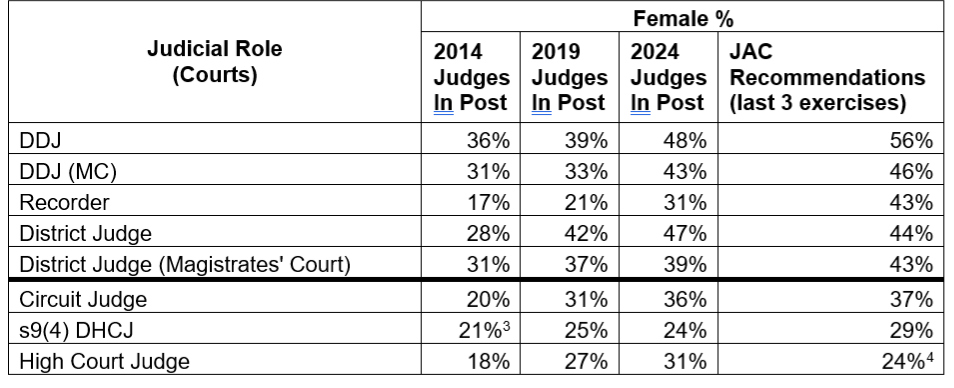
Some important trends indicated by this table include:
- For almost all roles listed, representation of women has increased significantly in the 10 years since 2014.
- Additionally, in almost all roles listed, the percentage of recommendations that were women in the most recent 3 exercises recruiting to these roles was greater than the 2024 representation of women. This, combined with the fact that women make up a relatively low percentage of those leaving the judiciary from courts roles (27% over the last 3 years), indicates that if the current trends are maintained, representation of women in these roles will continue to increase.
- At the District Bench, women are well-represented in county courts, with women making up just under half of both fee-paid and salaried judges here – for DDJs, representation looks set to exceed 50% in the near future. In the Magistrates’ courts, representation of women is lower than in county courts, but is increasing year on year.
- Women are less well represented in the higher salary-banded fee-paid roles. In the case of Recorder, women make up 31% at present, but have seen large increases in recent years which look set to continue based on recommendations from recent exercises.
- However, in the case of s9(4) Deputy High Court Judges, representation of women has not increased in the last 5 years (in fact, a small decrease), and recent exercises do not suggest that we can expect large increases in the coming years if trends are maintained.
- Representation of women among Circuit Judges has increased significantly in the last 10 years, to current levels of 36%. However, the representation of women in recommendations across the most recent 3 selection exercises is only fractionally higher (37%), so if current trends are maintained the recent increases may stagnate.
- Representation of women among High Court Judges has increased in the last 10 years at a similar rate to that seen for Recorder, with women now making up 31%. However, the percentage of women recommended in recent selection exercises is lower (24%), indicating that if current trends are maintained, the percentage of women at the High Court will not increase further, and may decrease.
To assist with understanding roles where we see lower representation of women, particularly in relation to the roles in points 5-7 above, Table 2 below tracks female representation across the different stages of selection exercises for the same roles, averaged over the most recent three exercises.
Table 2 – female representation in selection exercises for courts roles (last three iterations)
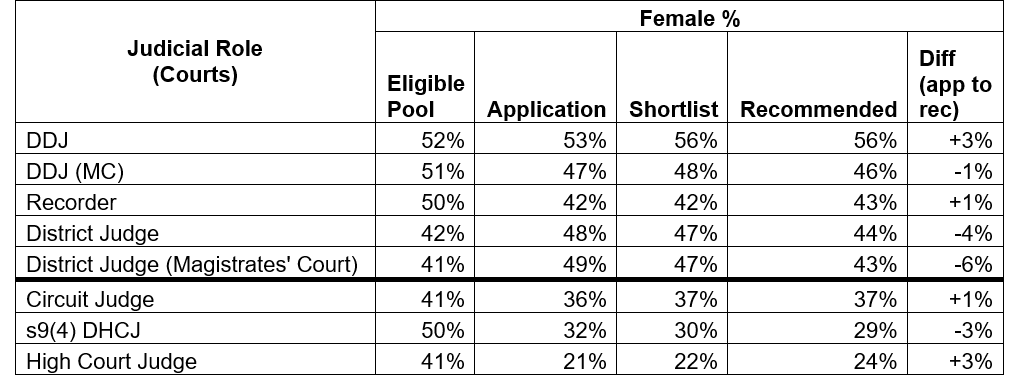
There are two possibilities to investigate: 1) are women applying in numbers we would expect based on their representation in the eligible pool, and 2) once applied, are women being successfully recommended at the same rate as men?
To first consider 2), the final column indicates the extent to which female representation has increased throughout an exercise (positive numbers) or “dropped off” (negative numbers). We see that there are no significant drop-offs in any exercise, including those below the bold line which were highlighted in Table 1, meaning that women are recommended broadly in line with their representation in applications, and at the same rate as men.
Therefore, the issue to focus on is 1), the lower representation of women seen in the applications column for the highlighted roles. The representation of women in the eligible pool for each role is estimated in the table, and we can see that for the roles in question, representation of women is significantly lower in applications than in the pool of those eligible to apply. Some possible reasons for these disparities are explored below, beginning with Deputy High Court Judge.
Section 1.1 – applicant pool for Deputy High Court Judge
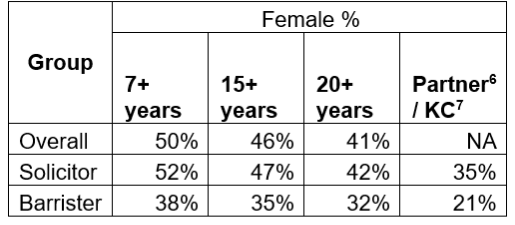
- For Deputy High Court Judge (DHCJ), the relevant eligible pool is those with 7 years’ post-qualification experience (PQE). Women make up 50% of this pool, which is estimated from data on practising barristers and solicitors, noting that Chartered Legal Executives are not eligible to apply for this role (this may not capture the pool in its entirety – for example, it does not capture solicitors and barristers who are not currently practising).
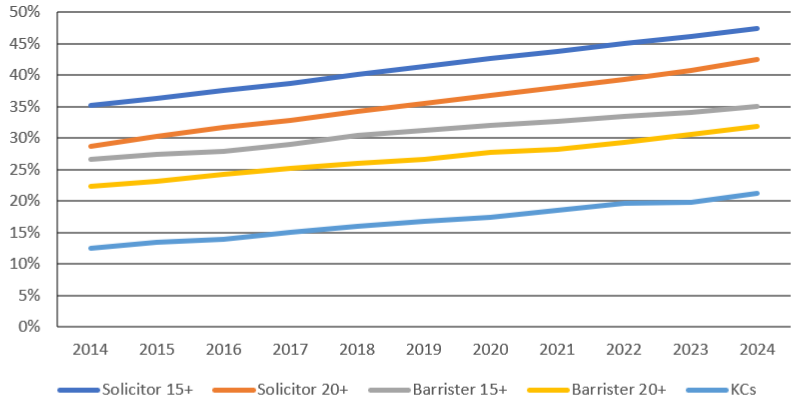
- However, the vast majority of applicants and those successfully recommended in DHCJ exercises have significantly more than the minimum of 7 years’ PQE. The 2024 statistics showed that for court positions requiring 7 years’ PQE, the average applicant had 25 years’ PQE.Representation of women in the pool of solicitors and barristers with 15+ years’ PQE is 46% overall, dropping to 41% in the pool with 20+ years’ PQE.
- The representation percentages above are largely driven by female representation in the solicitor pool, due to significantly higher numbers of solicitors than barristers overall. However, when looking at the last 3 DHCJ iterations, 70% of applications and 87% of recommendations have been for those with barrister backgrounds.
- Women make up 35% of barristers with 15+ years’ PQE, and 32% of those with 20+ years’ PQE, which is more in line with their representation in the applications for DHCJ exercises seen in Table 2.
- We are aware that KCs are well represented in new DHCJ appointments, as seen for example in this announcement from the judiciary in November 20232. Women make up just 21% of KCs, as of 2024 statistics.
Table 3 below summarises the relevant pool information from this section. The analysis above demonstrates that, although women comprise approximately half of those eligible to apply for the role of Deputy High Court Judge, when we consider the narrower pools from which applications and recommendations tend to come, representation of women is significantly lower.
Table 3 – female % in relevant professional pools for Deputy High Court Judge (2024 stats)
Graph 1 below displays the change in female representation in the key legal professional pools identified above in the last 10 years. The graph is encouraging in the sense that female representation has been continuously increasing in each pool year on year. However, it highlights the clear gaps between the barrister and solicitor profession at the more experienced levels. For example, women make up 35% of barristers with 15+ years’ PQE in 2024. This, in a sense, puts the barrister profession 10 years behind the solicitor profession, where women made up 35% of those with 15+ years’ PQE in 2014, while they now make up 47%. For KCs, female representation lags behind, and at the rate of change observed in the last 5 years (~1pp increase per year) sex parity in this pool would not be achieved until 2053 (29 years needed to go from 21% to 50%).
Graph 1 – female % in senior levels of the legal professions since 2014
Section 1.2 – applicant pools for Circuit Judge and High Court Judge
For Circuit Judge (CJ), representation of women in the eligible pool in the exercises analysed above in Table 2 was estimated to be 41%. Here, the key eligibility criterion is that previous judicial experience (PJE) is required. The eligible pool percentage was estimated from the proportion of sitting judges who were women at the time (in 2024 this has risen to 43%). This is unlikely to capture the full pool of those eligible – for example, individuals who have previously sat as a judge but have since left the judiciary would also be eligible to apply.
However, as we saw with the 7-year PQE eligible pool before, the majority of applications tend to come from a narrower pool than the full eligible pool, in which the representation of women is lower. Using 2024 statistics, the 43% representation of women among all sitting judges can be broken down as 38% representation among court judges and 53% representation among tribunals judges. The majority of applications and recommendations for Circuit Judge come from candidates with previous experience in courts roles. In particular large proportion of those successfully recommended tend to have experience sitting as a recorder, and Table 1 showed that women at present make up 31% of Recorders.
Similarly, the vast majority of applications and recommendations for High Court Judge (HCJ) come from candidates with previous experience in a narrow selection of courts roles. A very high proportion of those successfully recommended tend to have experience sitting as a Deputy High Court Judge, and Table 1 showed that women at present make up 24% of Deputy High Court Judges.
The above analysis demonstrates that, despite the eligibility criteria not dictating in which specific roles PJE is attained, there are certain roles which appear to comprise an established “career path” for Circuit Judge and particularly so for High Court Judge. Those with experience in other roles a) apply in very small numbers (a degree of self-filtering out) and b) are less successful at progressing through the exercise once they have applied. Women being less well represented in those key “feeder” roles appears to be a clear reason for their lower representation in applications for CJ and HCJ.
Section 1.3 – summary of insights
Although there has been significant progress for the representation of women across the majority of courts roles in recent years, we have identified three courts roles in which progress has been more limited, and in which, if present trends continue, the representation of women will not increase at a satisfactory rate. These roles are s9(4) Deputy High Court Judge, Circuit Judge and High Court Judge.
Analysis of exercises recruiting to these roles shows that, once applied, women have been successfully recommended at equal rates to men. However, women have applied in much smaller numbers than men, and in lower numbers than we would expect if applications were in line with the eligible pool.
Further analysis of the applicant pools for these exercises has demonstrated that applications tend to come from pools much narrower than the pool of all of those eligible to apply. For s9(4) Deputy High Court Judge, applications come predominantly from highly experienced barristers, who are often KCs. For Circuit Judge and High Court Judge, applications come predominantly from individuals who have held specific courts roles. Women are significantly less well represented in all of these pools than they are in the eligible pools.
Section 2 – female representation in tribunals roles
For completeness, we provide the equivalent statistics for the representation of women in Tribunals roles and exercises recruiting to them. Female representation in the last 3 iterations of JAC exercises recruiting to these roles is provided for roles where regular, non-chamber specific selection exercises are run (so not for the Upper Tribunal, where selection is generally chamber specific and not run on a regular basis).
Table 6 – female representation in judicial roles (tribunals)
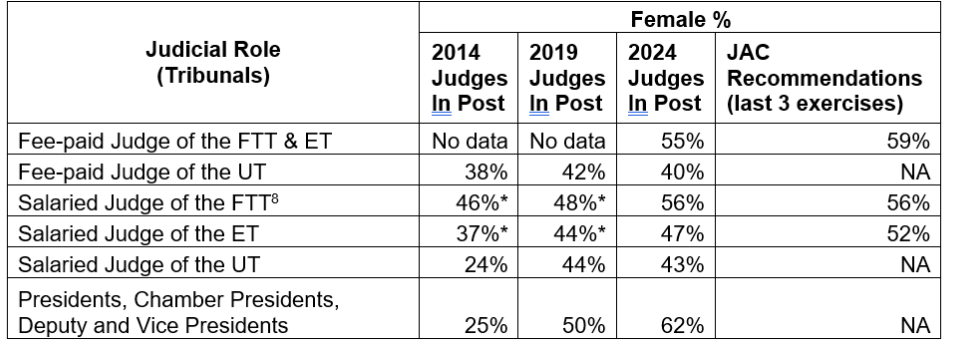
Table 7 – female representation in selection exercises for tribunals roles (last three iterations)
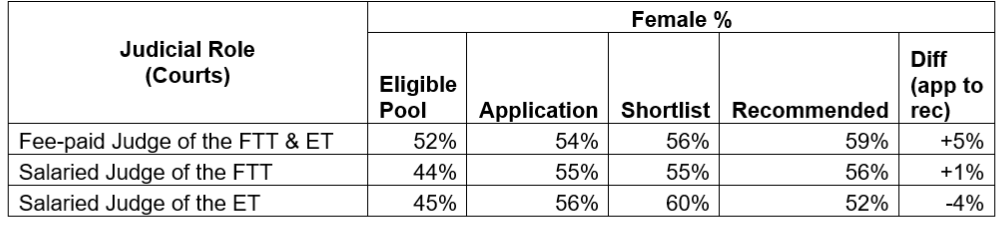
Women are currently well-represented in all of the above roles, although representation remains slightly lower in the Upper Tribunal, both fee-paid and salaried, with no increase in representation in the last 5 years.
As of April 2024, there were approximately 100 positions in total across these roles (50 each salaried and fee-paid). The lower numbers mean that recruitment is chamber-specific and there can be larger time gaps between vacancies arising than in other roles. The 2024 statistics report covered selection exercises for fee-paid and salaried roles in the Upper Tribunal Immigration and Asylum Chamber, for which women made up 46% and 47% of recommendations respectively. As of 1 April 2024, when the snapshot of judicial diversity is taken, these individuals had not yet been onboarded, so we can expect to see increases next year. There
As of April 2024, there were approximately 100 positions in total across these roles (50 each salaried and fee-paid). The lower numbers mean that recruitment is chamber-specific and there can be larger time gaps between vacancies arising than in other roles. The 2024 statistics report covered selection exercises for fee-paid and salaried roles in the Upper Tribunal Immigration and Asylum Chamber, for which women made up 46% and 47% of recommendations respectively. As of 1 April 2024, when the snapshot of judicial diversity is taken, these individuals had not yet been onboarded, so we can expect to see increases next year. There were also two smaller exercises for salaried judges of the Upper Tribunal, for the Administrative Appeals Chamber and Tax and Chancery Chamber respectively. These made fewer than 10 total recommendations, so a diversity breakdown is unfortunately not available in the published statistics.
Section 3 – detailed ethnicity trends
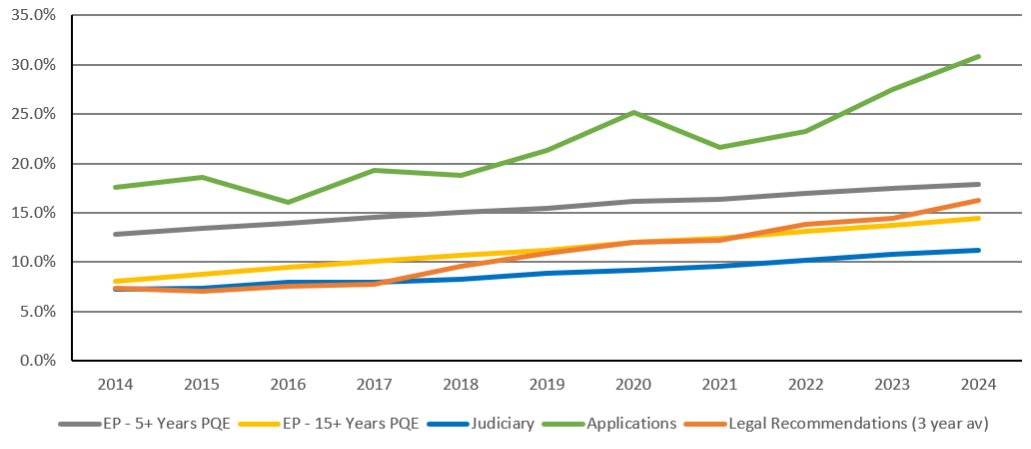
In last year’s statistical insights paper, we presented a graph plotting ethnic minority representation in JAC legal recommendations over time, alongside lines tracking ethnic minority representation in various sections of the eligible pool in the same years. The graph highlighted that 1) ethnic minority individuals apply for legal positions in numbers far higher than we would expect from their eligible pool representation; 2) ethnic minority representation in JAC recommendations has increased consistently year-on-year closely in line with ethnic minority representation in the more experienced pool of legal professionals (15+ years’ PQE). The same graph, updated with data from the 2024 statistics report, is below.
Graphs in this section contain 5 lines which represent:
- Grey line: ethnic minority representation in the pool of lawyers with 5 or more years’ legal experience (minimum amount needed to apply to a judicial role).
- Yellow line –representation in the pool of lawyers with 15+ years’ post qualification experience (PQE)).
- Blue line – representation in the sitting judiciary in each year, which we use to model the pool of individuals meeting the previous judicial experience criterion (PJE).
- Green line: ethnic minority representation in applications for legal roles.
- Orange line: 3-year average of ethnic minority representation in recommendations for legal exercises. A 3-year average is taken to smooth out some of the programme-related variation.
Graph 2 – ethnic minority representation in judicial appointments since 2014
The only new trends to highlight are:
- Ethnic minority candidates in 2024 were recommended in line with the average eligible pool for the second successive year, making up 16% of recommendations. This is reflected by the uptick in the orange line.
- Ethnic minority representation in applications reached a new high in 2024 at 31%, which is approximately twice the level of representation in the average eligible pool for 2024 selection exercises (15%). The previous high was 27% in 2023.
Data on judicial appointments has now been presented at a more granular ethnicity level (using 5 categories: Asian, black, mixed ethnicity, other ethnicity and white) for a sufficient number of years to allow us to begin to plot the equivalent graphs at the more granular level. We have also started to see these figures on a 1-year basis, where previously they were aggregated with the previous two years, which assists our ability to identify new trends.
Graph 3 – Asian representation in judicial appointments since 2014
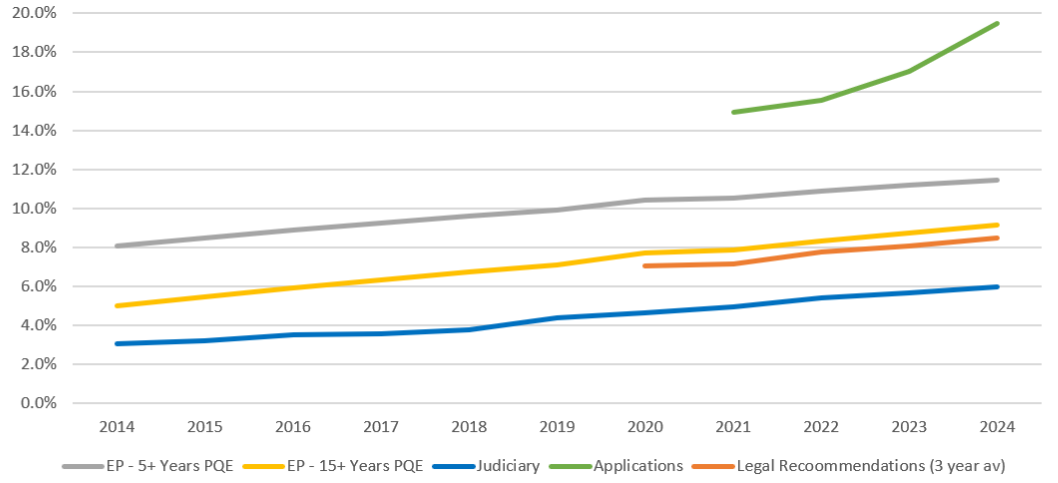
The Asian ethnicity graph above shows:
- Asian candidates apply in numbers significantly higher than representation in the eligible pool: they made up 19% of applications in 2024, while comprising 11% of the pool of lawyers with 5+ years’ PQE, and 9% of lawyers with 15+ years’ PQE.
- Asian representation in applications has grown significantly in the 3 years since 2021, outpacing growth in eligible pool representation.
- Asian representation in recommendations for legal judicial selection exercises has grown since 2020 approximately in line with Asian representation in the pool of lawyers with 15+ years’ PQE. Those with Asian ethnicity made up 9.2% of the pool of those with 15+ years’ PQE in 2024, and 8.5% of recommendations in the rolling 3-year average (8.7% in the single year 2023-24).
- Asian representation in the judiciary has doubled between 2014 (3.0%) and 2024 (6.0%).
Graph 4 – Black representation in judicial appointments since 2014
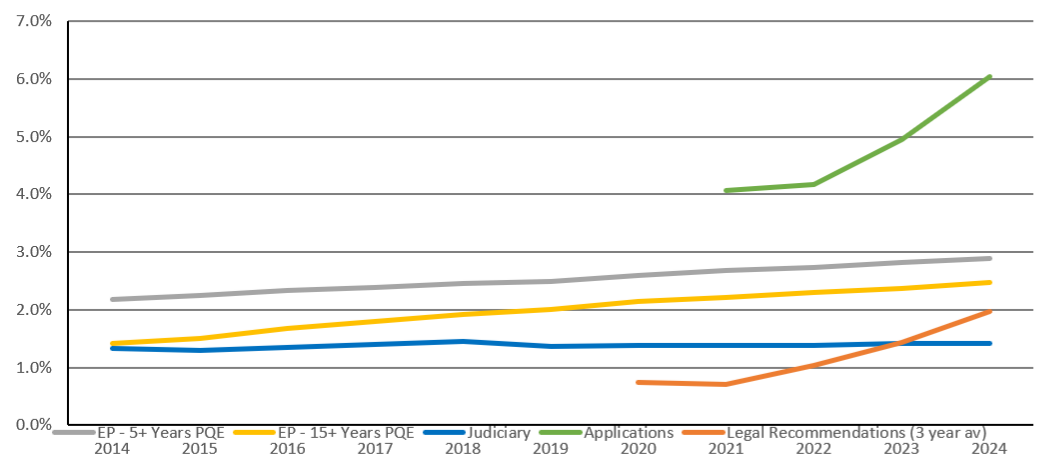
The graph tracking Black representation above shows:
- Black candidates apply in numbers significantly higher than representation in the eligible pool: they made up 6.0% of applications in 2024, while comprising 2.9% of the pool of lawyers with 5+ years’ PQE, and 2.5% of lawyers with 15+ years’ PQE.
- However, in the last two years, black representation in legal recommendations has seen a significant uptick to 2.0% (2.1% in the single year 2023-24). While this is still below eligible pool levels, it is an improvement in outcomes, although this does not yet appear to have resulted in an increase in black representation in the judiciary as yet.
- Black representation in applications has grown significantly in the 3 years since 2021, from 4.1% to 6.0%, approximately a 50% increase, substantially outpacing growth in eligible pool representation.
- Black representation in recommendations for legal judicial selection exercises has been significantly lower than representation in the eligible pools, and for some years was lower than representation in the sitting judiciary. For this reason, black representation in the judiciary has not grown in the 10 years since 2014, remaining stationary at around 1.4%.
Graph 5 – mixed ethnicity representation in judicial appointments since 2014
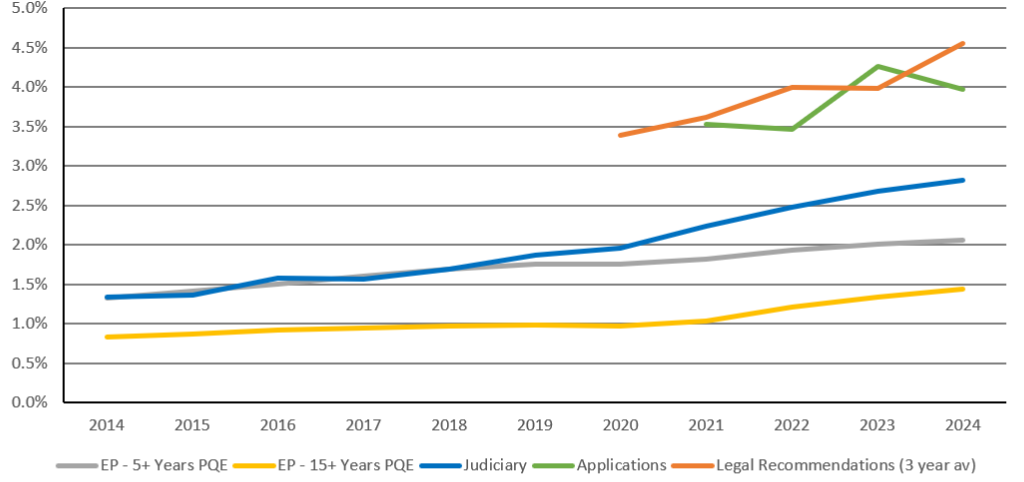
The graph above tracking mixed ethnicity representation shows:
- Individuals with mixed ethnicity have higher representation in the judiciary (2.8%) than in the eligible pool of those with 5+ years’ PQE (2.1%), and around double the representation in the pool of those with 15+ years’ PQE (1.4%).
- Candidates with mixed ethnicity comprise around 4.0% of applications, approximately double their representation in the pool of lawyers with 5+ years’ PQE (2.1%).
- They have been recommended in line with those application levels, comprising 3.5 to 4.5% of recommendations over the last 5 years.
- Representation of mixed ethnicity individuals in the judiciary has doubled since 2014, from 1.3% to 2.8%, with this growth outstripping eligible pool growth since 2020.
For the final ethnic minority sub-group, Other Ethnic Minority, numbers are too small to produce a meaningful equivalent graph. However, the 2024 diversity statistics indicate that over the last 3 years (2021 to 2024), those with other ethnicity have made up 1.0% of applications and 1.0% of recommendations for legal judicial selection exercises. They comprised 1.4% of the average eligible pool across these exercises.
- In 2023-24 CILEX lawyers were eligible to apply for the following judicial posts (including fee-paid or “deputy” equivalents): District Judge, District Judge (Magistrates’ Courts), Judge of the First-tier Tribunal, Employment Judge, Road User Charging Adjudicator, Senior Coroners, Area Coroners and Assistant Coroners, Judge of the Upper Tribunal and Recorder (eligibility was expanded to include the latter two roles in 2023). ↩︎
- The JAC does not process data on which applicants are KCs as part of the selection process. ↩︎