
Diversity Update – January 2026
Detailing our ongoing work to attract and better prepare potential candidates from under-represented groups for judicial appointments.
Introduction (Back to top)
The JAC Diversity Update is a biannual publication that reports on ongoing progress and new activity undertaken by the JAC in line with the JAC’s diversity strategy. The strategy has three key strands:
- outreach
- fair and non-discriminatory selection processes
- working with others to break down barriers
Foreword from Lord Justice Warby, JAC Vice Chair
I am pleased to introduce the Judicial Appointments Commission’s Diversity Update for January 2026.
Ensuring that appointments are made from as diverse a pool as possible is central to our statutory mission. To achieve this, our processes must be accessible and clear. This update reflects the continued progress we are making on these fronts.
Over the past year, we have strengthened our approach to helping candidates from under-represented groups, introduced clearer and more accessible recruitment standards through the revised Judicial Skills and Abilities Framework, and strengthened our partnerships within the Judicial Diversity Forum.
These are meaningful developments, which sit alongside the JAC’s ongoing commitment to ensuring that all selection processes are robust, evidence-based, and fair.
We look forward to building on this progress in the year ahead as we continue to play our part in ensuring a high-quality, diverse modern judiciary.
In doing so, we recognise that challenges remain. We are therefore continuing to evaluate our processes and their outcomes, to enhance our support for candidates, and to collaborate with partners to identify and address the factors that influence diversity in applications and appointments for judicial office.
I am grateful to our partners across the justice system for their continued collaboration. I also want to acknowledge the hard work put in by the candidates with whom we work and by those who provide us with evidence about candidates’ skills and abilities.
– Lord Justice Warby, JAC Vice Chair
Background of the JAC
The JAC’s purpose is to independently select candidates for judicial appointment through fair, evidence-based processes that support a strong and diverse field of applicants. Under the Constitutional Reform Act 2005, the Judicial Appointments Commission’s (JAC) statutory duties are to:
- select candidates solely on merit
- select only people of good character and
- have regard to the need to encourage diversity in the range of persons available for selection.
The JAC has identified four groups that remain under-represented in the judiciary: women, ethnic minority individuals, disabled individuals, and solicitors. All protected characteristics under the Equality Act 2010 are considered when carrying out equality measures.
The Diversity Update is a biannual publication that reports on progress and new activity aligned with the JAC’s diversity strategy. The strategy focuses on outreach to broaden the pool of applicants, maintaining fair and non-discriminatory selection processes, and working with partners to address barriers to judicial appointment.
Recent highlights
- The updated Judicial Skills and Abilities Framework (JSAF) is now live, supported by new webpages outlining its implications for JAC selection. All exercises from October 2025 onwards are using the revised framework. It is supported by clearer guidance on application and assessment.
- The approach to statutory consultation, revised in 2022, was reviewed in 2025. The evaluation confirmed the model is working effectively, with most candidates now involved in exercises where statutory consultation has been waived. Read the evaluation of the revised approach to statutory consultation and the updated guidance on statutory consultation.
- In 2025, the JAC commissioned the Work Psychology Group to analyse leading practice for supporting neurodiverse candidates. Their findings have been published, several recommendations adopted, and a comprehensive review of the reasonable adjustments policy is scheduled for 2026.
- The JAC has collaborated with the Ministry of Justice’s Website Builder team to develop a new website, aimed at improving functionality, accessibility, and overall user experience. The site is due to be launched in early January.
- In November 2025, the JAC hosted its first large-scale candidate seminar, attended by over 400 prospective applicants. The JAC also contributed to wider outreach activity, presenting at more than 40 external events throughout 2025.
Section one – outreach and support (Back to top)
New activity
- The Targeted Outreach programme continues to support candidates in all legal selection exercises. As of December 2025, the programme has received over 1,190 applications, of which, following sifts by former JAC Commissioners, 666 candidates are taking part in the programme and receiving support from a former Commissioner and/or a Judicial Guide. Of accepted candidates, 71% are women, 61% are ethnic minority, 19% declared a disability, and 67% are solicitors.
- Over the last 6 months, we have enhanced the Targeted Outreach programme delivery through the following activities:
- Delivery of interactive training sessions for all Judicial Guides, utilising peer expertise to inform consistent and high-quality support to candidates.
- Development and launch of stage-by-stage resources for Targeted Outreach programme candidates, from November 2025.
- Collaboration with specific jurisdictions to develop bespoke insight resources targeted at under-represented candidates.
Ongoing activity
- Monitoring and evaluation remain central to the Targeted Outreach programme. Analysis shows that female ethnic minority solicitors on the programme have been appointed at rates approximately two and a half times higher than comparable candidates over the last three years, and Black candidates have been shortlisted at around twice the rate of all Black applicants to legal exercises.
- As of December 2025, 57% of participants who have been on the programme for at least 12 months and made at least one application have reached a selection day or been recommended for appointment, and 33% have been successfully recommended for a judicial role.
- The Judicial Guide scheme continues to provide targeted support to candidates navigating the JAC selection process. To date, over 355 candidates have received support from a member of the judiciary, and 153 Judicial Guides have been trained and accredited through the scheme.
- We continue to deliver an extensive programme of outreach activities, supporting over 40 events in 2025. Recent events include the Becoming a Judge seminar hosted by the Law Society and the SEAL (Society of English & American Lawyers) webinar.
- The JAC remains a key partner in the delivery of the Pre-Application Judicial Education (PAJE) programme and supported a review of the programme in 2025. Evidence indicates that PAJE successfully targets under-represented groups and correlates with improved success rates in judicial exercises. The JAC will support implementation of the review’s recommendations in 2026.
Section two – fair and non-discriminatory selection processes (Back to top)
New activity
- The judiciary published a revised Judicial Skills and Abilities framework in January 2025. The JAC supported its development and exercises launching from October 2025 now operate under the new framework. Further information is available on the website. The framework sets out what is universally expected of those in judicial roles and it has been developed to be comprehensible and accessible to all.
- In 2025, the JAC commissioned the Work Psychology Group to provide expert advice on its shortlisting approaches. This work provided assurance that current processes align with best practice and are appropriate to the JAC’s context.
- The JAC also commissioned the Work Psychology Group to review neurodiversity best practice. The findings have been published, and several recommendations have already been implemented. A review of the reasonable adjustment policy will take place in 2026. Read the review on neuroinclusive judicial recruitment – executive summary.
- The JAC is conducting a comprehensive review of the Equal Merit Provision (EMP), which currently applies to women and ethnic minority candidates. The review will assess whether evidence exists to expand EMP to other protected characteristics, such as disability, with completion expected in Spring 2026.
Ongoing activity
- The JAC applies robust quality assurance checks throughout every stage of the selection process to ensure fairness and prevent bias. All protected characteristics under the Equality Act 2010 are considered, alongside broader factors such as socio-economic and professional background.
- Selection exercise materials are developed with independent expert advice and are reviewed throughout their development for potential unfairness. Each exercise is overseen by a JAC Commissioner, materials are reviewed by staff and the advisory group, and all assessments are tested with mock candidates to refine content and timing.
- The selection process is actively monitored, including progression analysis for target groups, briefing panel members on fair selection before each stage, and observing all elements of the process to ensure consistency and adherence to fair selection principles.
- Since September 2021, the JAC has monitored the ethnic diversity of panels for each selection exercise, working with the Judicial Office to convene balanced lay and judicial panels. The pool of 306 judges comprises 52% women, 19% ethnic minority judges, and 49% solicitor judges. Among lay panel members, 76% are women, 21% are ethnic minority, and 13% have declared a disability. Panel diversity data has been included in the JAC Annual Report since 2022.
- The JAC is committed to attracting Welsh-speaking panel members and increasing the observation of lay panels to support a positive candidate experience, alongside wider work to enhance recruitment, retention, and development of lay panel members.
- Changes to statutory consultation introduced in 2022 were evaluated in 2025. The evaluation found the revised approach to be effective, with most candidates now participating in exercises where statutory consultation is waived. The JAC has worked with stakeholders to ensure candidates are aware of the guidance documents and published material available to them in advance of applying for any exercise. Read the evaluation of the revised approach to statutory consultation and the updated guidance on statutory consultation.
- Reasonable adjustments are considered at all stages of the selection process, with candidates invited to request adjustments at the application stage and again ahead of each assessment stage, for candidates with physical, sensory, and mental health disabilities, and long-term health conditions.
- The JAC continues to make full use of the EMP to advance diversity where two or more candidates are judged to be of equal merit. EMP can be applied at shortlisting and final decision-making for under-representation in ethnicity or gender. During the 2024–25 reporting period, 32 candidates were advanced at shortlisting, and 6 candidates were recommended at final decision-making as a result of EMP.
Section three – working with others to break down barriers (Back to top)
New activity
- The JAC has continued to work with Judicial Diversity Forum (JDF) partners throughout 2025 to deliver the JDF’s agreed priorities. This includes joint activity to promote diversity and outreach, and ongoing work to develop a centralised online “hub” to help candidates access support across all JDF partner initiatives.
- The JAC is also widening its engagement with stakeholder groups to deepen understanding of their priorities and inform collaborative action on judicial diversity. As part of a project addressing the under-representation of Black lawyers, the JAC hosted a roundtable with Black legal professionals in December 2025 to discuss their experiences of the legal professions, the appointments process and the judiciary.
- Internationally, the JAC continues to share best practice on judicial appointments. In October 2025, we hosted the Chief Justice of Malaya and a delegation of Malaysian judges, focusing on the selection process and diversity initiatives and the JAC continues to work alongside Judicial Office and the Foreign and Commonwealth Office to support and engage with judicial appointments bodies and judicial office holders from other jurisdictions, including international engagement.
Ongoing activity
- The JAC chairs the JDF, which brings together key partners across the justice system to provide strategic direction, address structural barriers to appointment, analyse differential outcomes, and coordinate joint activities to increase judicial diversity.
- We continue to work with the Ministry of Justice and His Majesty’s Courts and Tribunals Service to promote flexible working in judicial vacancies. The JAC’s position remains that flexible working should be offered by default unless there are clear and specific reasons why it is not practical, and we have seen a gradual shift towards this approach.
- The JAC also continues to publish blogs to highlight different aspects of our work. Recent posts have included contributions from former Commissioners Barry Morgan and Sue Hoyle on the importance of lay perspectives, as well as features on the role and impact of lay panel members.
Section four – diversity data (applications and outcomes) (Back to top)
This section presents diversity data on JAC applications and outcomes, drawn from the JDF’s annual Diversity of the Judiciary Statistics Report, published in July 2025.
Lawyers in the eligible pool for legal exercises
The ‘eligible pool’ comprises lawyers meeting the minimum statutory criteria for judicial appointment (typically, at least 5 years of post-qualification legal experience). Data from the Bar Standards Board, Solicitors Regulation Authority and the Chartered Institute of Legal Executives shows that diversity in the eligible pool is increasing.
However, applications for judicial appointment tend to come from lawyers with more experience than is required by statute. During the 2024-25 reporting period, applicants to roles requiring five or more years’ experience held an average of around 18 years post-qualification experience. Diversity at more experienced and senior levels of the legal professions remains lower, although this is increasing.
Legal exercises
- Women accounted for 49% of the eligible pool, 49% of applications, and 52% of recommendations.
- They were therefore recommended broadly in line with representation. For the third consecutive year, women had a slightly higher recommendation rate from application than men (10% compared with 9%). This reverses a long-standing pattern, as men were recommended at a higher rate in all but one of the six years prior to 2022/23.
- Women remain under-represented in applications and recommendations for some senior courts exercises, as explored in the Statistical Insights section of the February 2025 Diversity Update. Women made up 38% of those recommended for Circuit Judge and 32% of those recommended in Small Court Exercises1, significantly below representation in the eligible pools for these roles. Outcomes for women in the 2024-25 Recorder exercise, which is known to be the key feeder role for Circuit Judge were more positive, with women making up 50% of recommendations for Recorder this year, for the first time since 2015-16 and only the second time on record.
- Ethnic minority candidates made up 17% of recommendations, having made up 15% of the average eligible pool. This is the highest representation of ethnic minority candidates in recommendations on record and marks the third consecutive year in which ethnic minority candidates were recommended in line with, or above, eligible pool representation.
- Ethnic minority candidates accounted for 27% of applications, significantly higher than eligible pool representation. There continues to be a large drop-off in ethnic minority representation at the shortlisting stage (27% down to 19%), and recommendation rates from application remained around 50% lower than for White candidates (6% of ethnic minority applicants were successfully recommended, compared with 11% of White applicants).
- When measured as a proportion of the eligible pool, ethnic minority candidates were recommended at a slightly higher rate than White candidates, reflecting their significant overrepresentation at the application stage.
- More granular ethnicity statistics for 2024-25 legal exercises were as follows:
- Asian: 9.3% of eligible pool, 17% of applications, 11% of those shortlisted, 8.6% of recommendations.
- Black: 2.3% of eligible pool, 5.0% of applications, 2.0% of those shortlisted, 1.9% of recommendations.
- Mixed ethnicity: 2.6% of eligible pool, 4.2% of applications, 4.9% of those shortlisted, 5.8% of recommendations.
- Other ethnicity: 1.3% of eligible pool, 0.9% of applications, 1.1% of those shortlisted, 0.5% of recommendations. (Note that there were only 40 applicants who identified as Other ethnicity in this reporting year, so we advise against drawing conclusions from this small sample).
- Black, Asian, and Mixed ethnicity individuals were overrepresented at the application stage relative to the eligible pool. However, while Mixed ethnicity candidates’ representation increased through the selection process, Black and Asian representation decreased between application and recommendation, to approximately eligible pool levels. The majority of this decrease occurred at shortlisting, which is a pattern observed over several years.
- Black candidate representation in recommendations decreased slightly from 2023–24 (2.1% to 1.9%). This reflects expected year-to-year variation linked to the mix of exercises included in the reporting window. Black candidates, once shortlisted, were recommended at approximately equal rates to White candidates.
- Disabled candidates made up 11% of applications, 11% of those shortlisted and 8% of recommendations. They were therefore recommended at a lower rate than non-disabled candidates this year, with the drop in representation occurring at the selection day stage. Data for disabled candidates is explored further in the Statistical Insights section of this Diversity Update.
- Candidates with a solicitor background made up 56% of applications and 37% of those recommended. As in previous years, they were recommended at rates approximately half those of barristers (6% vs 13%) with the largest difference occurring at shortlisting.
- Candidates with a CILEX background made 104 applications for legal exercises (2%). This included 13 applications for Recorder, in the first year with eligibility expanded to include CILEX.
- 5 CILEX background candidates were successfully recommended, all for courts roles, including 2 recommended for Recorder. CILEX candidates were recommended at rates marginally lower than solicitors.
Non-legal exercises
The JAC selects candidates for recommendation as non-legal tribunal members using the same selection panels and tools as for legal exercises. The types of non-legal exercises included vary each year, and eligible pool representation differs significantly between exercises. As a result, diversity statistics for non-legal exercises can vary considerably year to year.
- Non-legal exercises continue to see positive target group representation. For 2024 to 2025 exercises, women accounted for 69% of recommendations for appointments to non-legal tribunals and had a higher recommendation rate from application than men.
- Ethnic minority candidates constituted 28% of applications and 23% of recommendations for non-legal tribunal posts in 2024-25. These recommendations can be further broken down as 15% Asian, 3% Black, 3% Mixed ethnicity and 2% “Other” ethnicity.
- Across all non-legal exercises in 2024-25, 33% of applications and 31% of those recommended for appointment declared themselves to have a disability. There was a large exercise recruiting for Disability Qualified Members of the First-tier Tribunal in 2024 25, which accounts for significantly higher representation of candidates with disabilities than in previous years.
Annex A – statistical insights from the 2025 Diversity of the Judiciary Report (Back to top)
This section presents some statistical insights from the 2025 report, which seek to go beyond the headline figures to provide further analysis and context.
Section 1 – disability analysis
It has been a JDF priority for several years to increase disability declaration rates across members’ datasets, in order to meet the 60% minimum required for publication. While JAC declaration rates have consistently been high (around 95%), lower rates for the judiciary and legal professions have created a significant evidence gap.
In the 2025 report, declaration rates for the judiciary, barristers, and CILEX lawyers were, for the first time, sufficiently high to allow disability data to be published alongside the JAC’s. This provides valuable new context for understanding JAC disability data within the wider judicial pipeline, and findings are set out below. However, declaration rates for solicitors remain below the publication threshold. As solicitors make up a large proportion of the eligible pool for most selection exercises, this continues to limit our understanding of disability among potential candidates. We understand that the SRA have taken steps
to increase declaration rates, which will be reviewed again ahead of the 2026 report.
Research suggests that legal professionals are not always comfortable disclosing their disability to employers, or during application processes, including anonymous equality monitoring surveys2. Therefore, it is possible that figures explored below underreport the representation of people with
disabilities.
Disability in the pool of eligible legal professionals, as of 1 April 2025
- 8% of barristers and 5% of Chartered Legal Executives eligible for judicial appointment (i.e., with at least 5 years’ PQE) declared a disability3. Taken as a combined pool, 7% of eligible barristers and Chartered Legal Executives declared a disability. When considering the more experienced pool of those with at least 15 years’ PQE, the percentages are unchanged.
- Although solicitor data is not yet available, the Solicitors Regulation Authority (SRA) published statistics for solicitors working in regulated law firms in 2023, covering approximately 60% of the profession. Disabled solicitors comprised 6% of this group. This indicates that lawyers with disabilities are likely to comprise between 6% and 7% of the full eligible pool, with solicitors included.
Disability in JAC applications for legal selection exercises (last 3 years)
- Over the last 3 years of selection exercises, (2022-23 to 2024-25), 10% of applicants for legal roles declared a disability. Comparing this to the combined pool above suggests that the JAC attracts applications from disabled lawyers above the level seen in the eligible pool.
- More detailed analysis shows that there was no significant variation in the proportion of applicants declaring a disability across the three legal professions, with between 9% and 10% of applicants from each profession declaring a disability. There was variation based on sex, with 12% of female applicants declaring a disability compared with 8% of male applicants. We do not know if this difference is reflected in the eligible pool, as data is not published at this level of detail, but Census data below reflects a similar difference.
- There was a small difference by ethnicity: a higher proportion of ethnic minority candidates declared a disability (11%) compared to White candidates (9%). Considering both ethnicity and sex together, 8% of White male candidates and 8% of ethnic minority male candidates declared a disability, while 10% of White female candidates and 14% of ethnic minority female candidates declared a disability.
- There was some variation with age, with 11% of candidates aged under 40 declaring a disability, 9% of candidates aged 40 to 49 and 50 to 59, and 11% of candidates aged 60 or above.
- Considering variation across different types of legal exercise, those requiring previous judicial experience (PJE) – typically, salaried exercises – had a slightly higher proportion of candidates declaring a disability (12%) than those not requiring PJE (10%). Exercises requiring PJE attract applicants largely from the pool of current judges, covered below.
- Exercises recruiting to Courts roles had a lower proportion of candidates declaring a disability (9%) than those recruiting to Tribunals roles (12%). This was true when considering fee-paid roles (9% Courts, 12% Tribunals) and, to a lesser extent, salaried roles (12% Courts, 13% Tribunals).
Progression rates in JAC legal exercises for those with disabilities
- Disabled candidates comprised 10% of applicants,10% of those shortlisted and 9% of those recommended in legal exercises in the last three reporting years (2022-25).
- As suggested by the small drop in representation through the selection process, disabled candidates were recommended at slightly lower rates than non-disabled candidates. However, this was not a statistically significant difference.
- Disabled candidates were shortlisted at slightly higher rates than non-disabled candidates, but were recommended from selection day at lower rates, and this was a statistically significant difference (40% success rate for disabled candidates, 47% for non-disabled candidates), but not a practically significant difference.4
- Restricting to the most recent year, disabled candidates continue to be shortlisted at the same or higher rate than non-disabled candidates, but the disparity in the rate at which candidates are recommended from selection day has grown (31% for disabled candidates vs 43% for non-disabled candidates), which is a practically significant difference. Further work is planned to understand reasons for this difference.
Disability in the judiciary, as of 1 April 2025
- 10% of judges declared having a disability – this is broken down as 8% of court judges and 15% of tribunals judges.
- There is significant variation across roles, with generally higher disability representation in salaried roles than in their fee-paid equivalents. For example, 14% of District Judges declared a disability, compared with 7% of Deputy District Judges; and 18% of Upper Tribunal Judges, compared with 8% of Deputy Upper Tribunal Judges.
- Considering roles with at least 100 judges, Salaried Employment Judges had the highest proportion declaring a disability (22%), and Deputy High Court Judges had the lowest (1%).
- There is likely to be some correlation with age in these statistics, since disability data from the 2021 Census indicates that the proportion of adults declaring a disability increases with each age band.
Comparison with disability in England and Wales
- The relevant group for comparison with the judiciary is the population aged 25 to 74. Data from the 2021 Census of England and Wales5 suggests that 18% of this population have declared a disability.
- Splitting by age bands, 13% of those aged 25 to 49 declared a disability, compared with 20% of those aged 50 to 59 and 26% of those aged 60 to 74. Splitting by sex, 16% of men aged 25-74 declared a disability compared with 20% of women aged 25-74.
- We are aware that other sources provide higher estimates for the percentage of people who have a disability. Both the Labour Force Survey (ONS) and the Family Resource Survey (DWP) provide data on disability status. Although their data breakdowns do not allow a calculation for the judicial comparator age group (25-74), for the “working-age adult” group, defined to be ages 16 to 64, both surveys estimated that 21% of the population had a disability at the time of the Census (March 2021), and 24% in the most recent iterations. The Census gave a figure of 15% for the equivalent age group6, which is a significant difference. We are seeking advice on which figures to use and reasons for differences across sources.
- A significant proportion7 of disabled people are categorised as permanently unable to work. Therefore, a more useful comparator group may be the economically active population aged 25-74.
- Again, there are varying sources for the proportion of disabled people who are economically active. This means that estimates for the proportion of economically active people aged 25-74 who are disabled range between 10% and 18%, depending on which sources are used.
- It will be important to gain consensus with JDF partners on which is the most appropriate comparator population, and which sources to use for the representation of disabled people within this population, to allow us to have a consistent understanding and interpretation of disability representation within the judiciary.
Annex B – dashboard trends for judges in post and eligible lawyers (Back to top)
The 2025 statistics report was published alongside an interactive dashboard for the first time. Access the dashboard for the diversity of the judiciary to create bespoke visualisations from the published data. The dashboard is particularly effective for viewing a “time series”, showing the representation of target groups in different judicial roles over time. By selecting the panel “Judges over time” and then adjusting the drop-down menus at the top of the page, you can explore diversity trends over recent years. Some examples are included below.
Panel 1 – female representation among Recorders
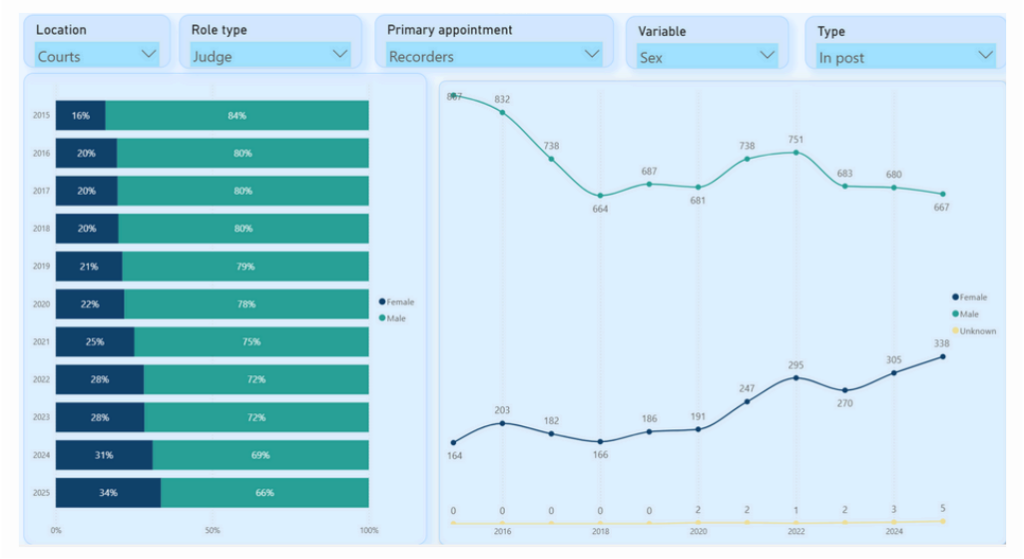
Panel 1 above shows the representation of women among Recorders in post since 2015. There has been a notable increase in female representation among Recorders since 2020, increasing from 22% to 34%. This is one of the fastest rates of change seen in the last 5 years. It has been driven by the fact that over 90% of those leaving the judiciary from Recorder roles have been men since 2020, and higher representation of women in JAC Recorder recommendations, including 52% in the 2024-25 exercise.
By contrast, female representation among Deputy High Court Judges has remained broadly static at around 25% since 2018. These roles are important to monitor, as both Recorders and Deputy High Court Judges are key feeder roles for the High Court. Representation of women among High Court Judges can also be viewed on the dashboard and has remained static at approximately 30% since 2021.
Panel 2 – ethnic minority representation among Circuit Judges
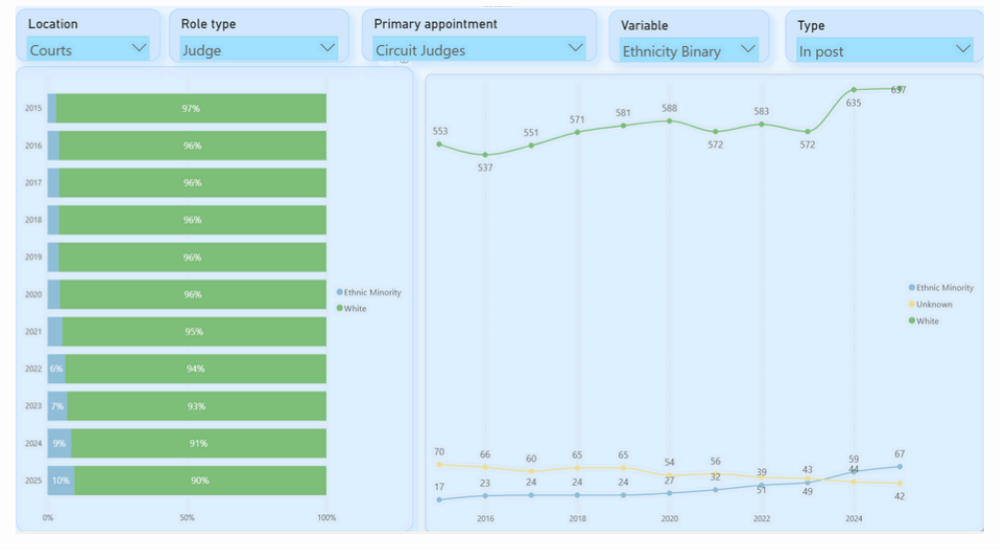
Panel 2 shows ethnic minority representation among Circuit Judges from 2015 to 2025. Representation increased from 3% in 2015, to 4% in 2020, and to 10% in 2025, indicating a marked acceleration in the rate of change over the most recent five years. A similar upward trend is observed across most judicial roles, including High Court Judge, where ethnic minority representation rose from 4% in 2020 to 9% in 2025. An exception is the Court of Appeal, which has had a single ethnic minority member since 2020, out of a total membership of between 36 and 39.
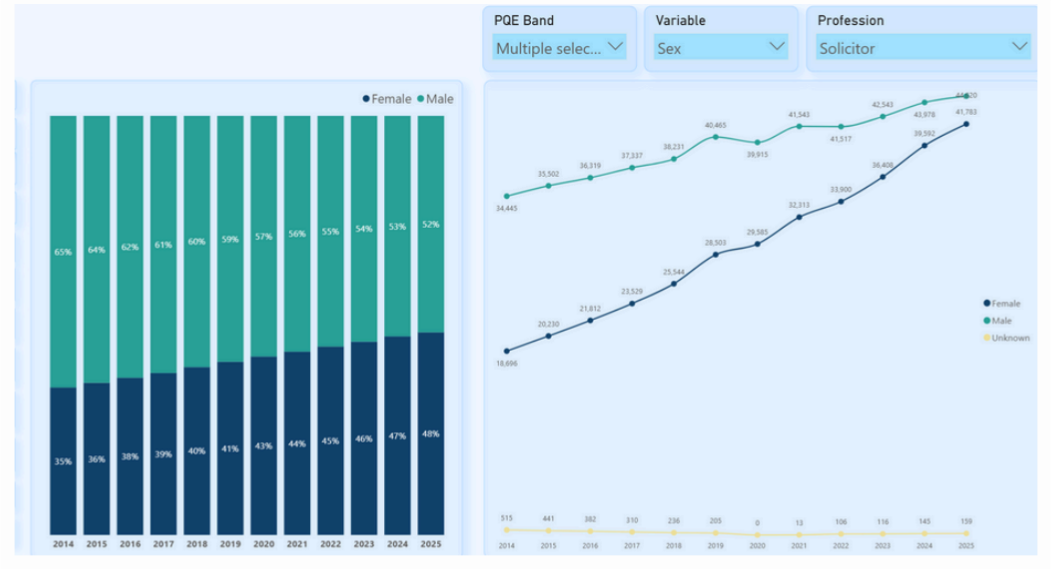
Panel 3 – female representation among experienced barristers
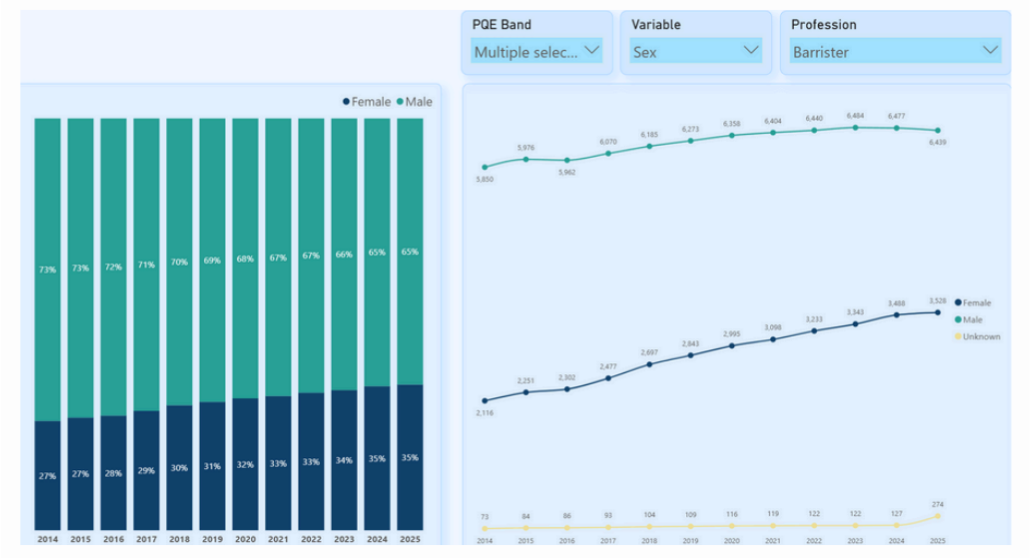
Panel 3 above draws on the “Legal Professions over time” dashboard view, with the profession set to Barrister and PQE bands selected for 15–19 years and 20+ years’ PQE. This group is of particular interest, as most applicants for judicial roles have at least 15 years’ PQE.
The data shows that female representation within this experienced barrister pool has increased year on year but remains substantially lower than in the equivalent solicitor pool (see Panel 4 below). This is significant in understanding lower female application rates for roles with typically high barrister representation, such as Deputy High Court Judge, as discussed in the Statistical Insights section of the February 2025 Diversity Update.
Panel 4 – female representation among experienced solicitors
Footnotes (Back to top)
- An aggregated set of exercises, to small to allow individual publication. These are typically senior roles. In 2024-25, this group included High Court Judge, Senior Circuit Judge and King’s Bench Master roles, among others. ↩︎
- See result on page 13 of Legally Disabled? report ↩︎
- Note that only 64% of barristers in this group declared their disability status, so there is uncertainty associated with this figure. For Chartered Legal
Executives, over 95% declared their disability status. ↩︎ - Differences in success rates between groups are judged to be practically significant in our Official Statistics if one is at least 20% proportionally lower than the other. This difference is a 14% proportional difference. ↩︎
- Disability in England and Wales, 2021 – Office for National Statistics. ↩︎
- The Census covers England and Wales, while the two surveys are for the United Kingdom. Also, the closest age group match possible in the Census data was 15-64. However, these differences do not account for the level of difference observed. ↩︎
- 31% of working age disabled people in the UK are economically inactive due to being ‘permanently sick or disabled’ (Family Resource Survey 2023-24,
Table 4.7) ↩︎